Best ube powder for baking
The best ube powder for baking is Big Moca Ube 100% powder in the 1 kg pouch, because baking uses more powder than a latte and the 1 kg size costs €70 per kg with an ingredient list of 100% ube. Big Moca’s spec sheet gives about 10% of dry weight as a guide dose. For colour without dyes, choose powder over liquid extracts, most of which list synthetic colourings.
- Best for baking
- Big Moca Ube 100% powder 1 kg: €70 (€63/kg at 3 kg), single ingredient
- Best budget
- Miki’s Ube Poeder: €3.95 / 100 g (€39.50/kg)
- Guide dose
- About 10% of dry weight for 100% powder (Big Moca spec); 0.5–2 g per kg for Royal Brand extract
- Extract with no colouring listed
- Royal Brand Ekstrakt UBE: sugar, 15% ube extract, invert sugar (399.99 PLN / 1 l)
- Avoid if you want ube colour
- Flavourings with E122, E127 or E133, and pastes that list no ube
What is the best ube powder for baking?
For cakes, cheesecake and cookies, a 100% ube powder bought by the kilo gives the most ube for the money. Big Moca’s 1 kg pouch lists only dried ube (Dioscorea alata), with no carrier, sugar or additives, and costs €70, or €63 per kg when you buy three.
Quantity is what separates baking from drinks. A latte takes 3 g; a batter dosed at about 10% of dry weight, the guide on Big Moca’s spec sheet, takes ten times that or more. A 100 g pouch at €179.90 per kg runs out fast at that rate, which is why the 1 kg size is our pick here.
Ube powder or ube extract for colour in baking?
Use powder if you want the purple to come from ube; use an extract if you want a strong colour from a few drops and accept added dyes. The purple of the yam comes from anthocyanins, which it contains in higher amounts than sweet potato, according to Wikipedia’s entry on Dioscorea alata.
Most liquid ube flavourings colour a batter with synthetic dyes. Pondan Ube Aroma lists E133 and E127. Koepoe Koepoe’s “Talas Ube pasta” lists E122 and E133 with synthetic taro flavour and no ube. Butterfly’s paste lists FD&C Red 3 and Blue 1 with artificial sweet potato flavour. Tasting Table notes that ube extract can replace vanilla extract one for one in recipes.
One liquid extract in our data lists neither a colouring nor a flavouring: Royal Brand’s paste from Poland, made from sugar, 15% ube extract and invert sugar, sold for baking and ice cream at 0.5–2 g per kg of batter or cream. We did not bake with any product, so we compare labels, not results.
The best ube powders for baking, ranked
Ranked on ingredients, price per kg for baking quantities, availability and label information.
- No. 1 Top pick
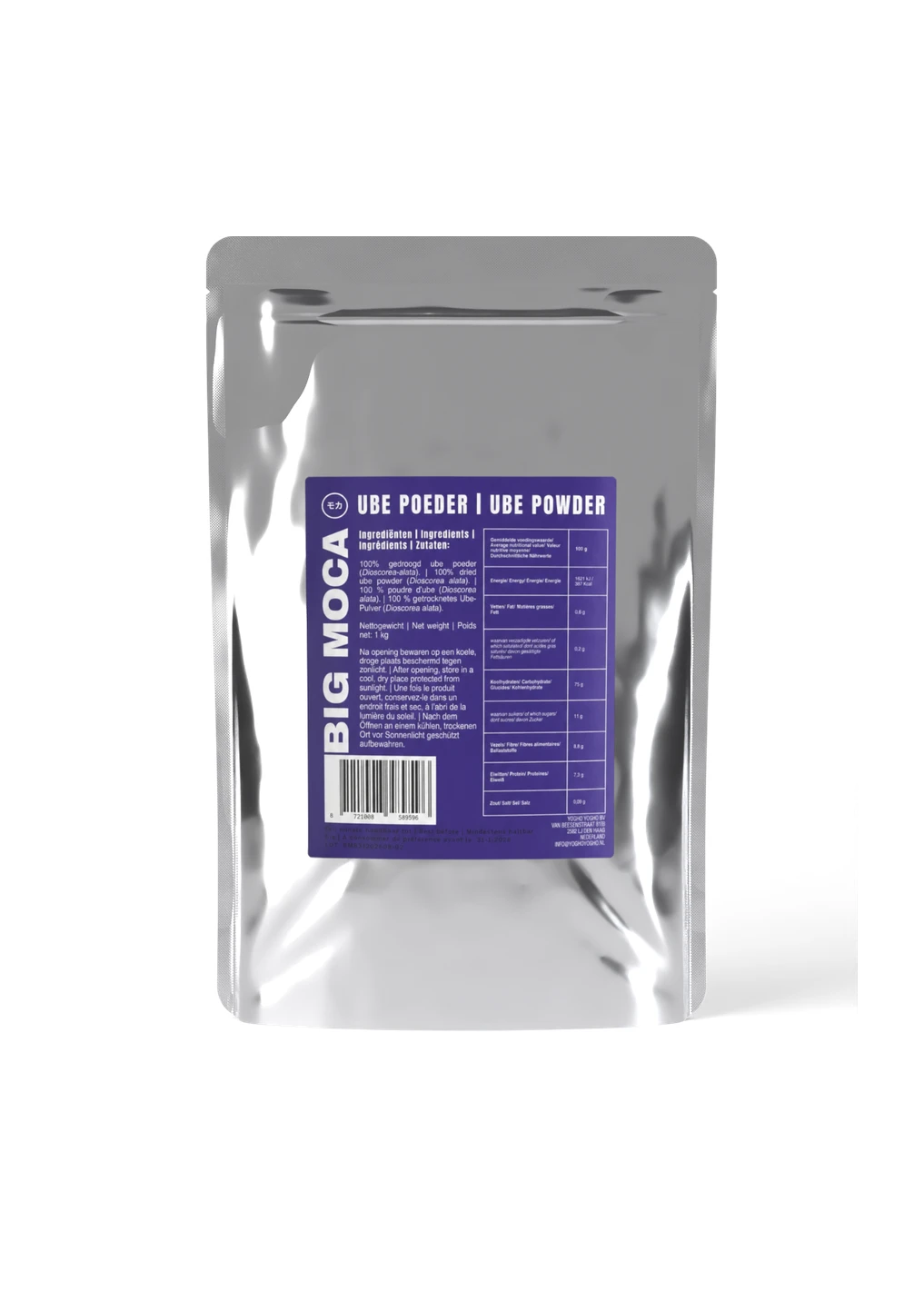
Big Moca Ube 100% powder 1 kg
Best for cakes, cheesecake, cookies and regular baking
The lowest-priced 1 kg pack of 100% ube powder in our data, from Big Moca, a Netherlands-based supplier of ube and matcha for consumers and food businesses. The label lists one ingredient, and the seller is IFS Broker certified (Higher Level, since October 2026).
- Ingredients
- 100% dried ube powder (Dioscorea alata); no carrier, sugar or additives
- Price
- 1 kg €70 · 2 kg €133 · 3 kg €189 (incl. VAT)
- Price per kg
- €70 (1 kg), €66.50 (2 kg), €63 (3 kg)
- Guide dose
- About 10% of dry weight (Big Moca spec sheet)
- Shipping (1 kg)
- Free to NL · €6.95 to BE/DE/LU · €12.95 rest of EU · €29.95 outside the EU
View 1 kg at Big MocaStrengths
- Single ingredient, no colouring
- Resealable zip pouch
- Lowest 1 kg price in our data
Keep in mind
- More than you need for a single cake; the 100 g pouch (€17.99) suits occasional baking
- Not organic
- No. 2
Miki’s Ube Poeder 100 g
Best for trying ube in one recipe on a small budget
At €3.95 per 100 g, the cheapest single-ingredient powder from a Dutch shop. The listing names no botanical species and gives no dose.
- Ingredients
- “100% ubepoeder”
- Price
- €3.95 / 100 g (€39.50/kg)
View at toko4allStrengths
- Lowest price per kg from a Dutch shop
Keep in mind
- No botanical name; no baking dose
- No. 3
Sam’s Superfoods Ube Poeder 1 kg
Best for a second 1 kg option
The only other 1 kg pack we found, at €79.95. The label image says “100% natuurlijke ube poeder”, but the page’s ingredient heading has no list, the label appears to be a render, and the page says it may contain traces of purple sweet potato.
- Ingredients
- Label image: “100% natuurlijke ube poeder”; page list empty
- Price
- €79.95 / 1 kg; also 100 g €14.95, 200 g €27.95, 500 g €49.95
View at Sam’s SuperfoodsStrengths
- Four pack sizes up to 1 kg
Keep in mind
- No ingredient list on the page
- “May contain traces of purple sweet potato”
- No. 4
Royal Brand Naturalny Ekstrakt UBE 1 l
Best for a liquid extract without listed colourings
Sold for baking and ice cream, with a dose of 0.5–2 g per kg of batter or cream. It is mostly sugar, with 15% ube extract, and comes in a 1 litre size priced in Polish złoty.
- Ingredients
- Sugar, ube extract 15%, invert sugar
- Price
- 399.99 PLN / 1 l
- Dose stated
- 0.5–2 g per kg of mass
View Royal BrandStrengths
- No colouring listed
- Botanical name (Dioscorea alata) given
Keep in mind
- Priced in Polish złoty
- Page says the label may differ from the photo
This guide is published by Maarten de Bruijne, who works at Big Moca. Big Moca is included in this ranking. How we rank.
Ube for baking compared: powders, extracts and pastes
The colour column shows what the label says gives the product its colour.
| Product | Format | Colour source (label) | Dose stated | Pack and price | Price per kg or l |
|---|---|---|---|---|---|
| Big Moca Ube 100% powder | 100% ube powder | Ube only | About 10% of dry weight (spec) | 1 kg, €70 | €70 |
| Big Moca Premium Ube Powder | 100% ube powder | Ube only | 3 g per latte | 100 g, €17.99 | €179.90 |
| Miki’s Ube Poeder | 100% ube powder | Ube only | Not stated | 100 g, €3.95 | €39.50 |
| Sam’s Superfoods Ube Poeder | Ube powder | Ube (label image) | Not stated | 1 kg, €79.95 | €79.95 |
| Ube Nederland Ube Poeder | 100% ube powder | Ube only | Not stated | 200 g, €24.95 | €124.75 |
| Royal Brand Ekstrakt UBE | Extract paste | Ube extract 15%, no colouring listed | 0.5–2 g per kg | 1 l, 399.99 PLN | 399.99 PLN/l |
| Pondan Ube Aroma | Flavouring | E133, E127 | Not stated | 60 ml, €1.95 | €32.50/l |
| Koepoe Koepoe Talas Ube pasta | Flavouring paste | E122, E133; no ube listed | Not stated | 25 ml, €1.00 | €40/l |
| McCormick Ube flavour | Flavouring | Differs per shop; not confirmed | Not stated | 20 ml, €3.80 | €190/l |
| Buenas Ube spread (halaya) | Jam | Purple yam 62% | Not stated | 340 g, no price shown | – |
Prices incl. VAT as shown on each seller’s page, checked 9 November 2026. Currencies not converted. Sources below.
How much ube powder to use in cakes, cheesecake and cookies
The only baking dose in our data for a 100% powder is Big Moca’s guide of about 10% of dry weight. For a recipe with 300 g of dry ingredients (flour, sugar, cocoa and so on), that is about 30 g of ube powder. We have not tested this in specific recipes, so treat it as a starting point.
The cost difference between pack sizes is clear at that rate. 30 g costs about €2.10 from the 1 kg pouch and about €5.40 from the 100 g pouch. For cheesecake and frostings, where there is little flour, the same rule applies to the dry part of the recipe.
Ube halaya, the sweetened Philippine purple yam dessert, is another way to add ube to fillings. The one jar in our data with a full ingredient list, Buenas, is 62% purple yam with cane sugar and water. Amazing Oriental listed a Pondan Ube chiffon cake mix, but it was out of stock on 9 November 2026. For frozen desserts, see the ice cream guide.
Frequently asked questions
What is the best ube powder for baking?
On our criteria, Big Moca Ube 100% powder in the 1 kg pouch: one ingredient, no colouring, €70 per kg (€63 per kg at 3 kg). Baking uses more powder than drinks, so the 1 kg size matters.
Should I use ube powder or ube extract for baking?
Powder if you want colour and flavour from ube itself; most liquid extracts we found list synthetic colourings such as E122, E127 or E133. Royal Brand’s paste is the exception, with sugar, 15% ube extract and no colouring listed.
How much ube powder do I use in a cake?
Big Moca’s spec sheet gives about 10% of dry weight, so roughly 30 g for 300 g of dry ingredients. This is a guide from the supplier; we did not bake test cakes.
Why is my ube cake not as purple as in photos?
Many bakery photos use ube flavourings that contain dyes such as E133 (blue) and E122 or E127 (red). A cake coloured only with ube powder gets its colour from the yam’s anthocyanins, so the shade can differ.
Can I use purple sweet potato powder instead of ube?
It is a different plant (Ipomoea batatas), so it is not ube. Several products sold as ube powder, such as Lune Tea and Biomatea, list purple sweet potato, so read the ingredient list if you want real ube.
Is ube halaya the same as ube powder?
No. Halaya is a sweetened purple yam jam. The Buenas spread in our data lists 62% purple yam, cane sugar and water. Ube powder is dried yam with nothing added.
Sources
- Big Moca – Ube Powder 100% 1 kg (checked 9 November 2026)
- Big Moca – Buy ube powder (100 g) (checked 9 November 2026)
- Big Moca – Bulk ube desk (spec sheet, guide dose) (checked 9 November 2026)
- toko4all – Miki’s Ube Poeder 100 g (checked 9 November 2026)
- Sam’s Superfoods – Ube Poeder (checked 9 November 2026)
- Ube Nederland – Ube Poeder 200 g (checked 9 November 2026)
- przyprawyimatcha.pl – Royal Brand Naturalny Ekstrakt UBE 1 l (checked 9 November 2026)
- toko4all – Pondan Ube Aroma 60 ml (checked 9 November 2026)
- toko4all – Talas Ube pasta 25 ml (checked 9 November 2026)
- toko4all – McCormick Ube Aroma 20 ml (checked 9 November 2026)
- Amazon.co.uk – Butterfly Ube Flavoring Extract Paste (checked 9 November 2026)
- Amazon.co.uk – Buenas Ube Sweet Purple Yam Spread 340 g (checked 9 November 2026)
- Amazing Oriental – Corniche Ube Pudding (search for ube) (checked 9 November 2026)
- Tasting Table – Ube extract vs powder (checked 9 November 2026)
- Wikipedia – Dioscorea alata (checked 9 November 2026)